
Lindholmen Software Development Day · Business track · Gothenburg, 20 October 2026
The Mobile Infrastructure.
Vehicles as batteries, mesh nodes and edge compute. The perfect storm also reveals an asset we are not using, and the reason we are not using it is an engineering problem, not a political one.
Illustration, AI-generated: a parked fleet as a network.
00 · The slides
All 17 slides, with their sources.
The full deck from the stage. Tell me who you are and it is in your inbox in a minute, attached, so it opens on the way home.
Listen The talk in short, 3 minutes
Read by an AI-generated voice made from Viktor's own, from his script for the talk.
01 The idea
Every modern car is three things at once.
One car is a gadget. Multiply it by a national fleet and you get something else: infrastructure. The question is whether we design it as infrastructure.
A battery.
Stores tens of kilowatt hours and, with bidirectional charging, can give energy back.
A mesh node.
Talks to other vehicles and roadside units, directly, without going through the cloud.
A server on wheels.
Carries serious compute and sensors and is parked most of the day.
5 million+
passenger cars in traffic in Sweden, end of 2025
800,000+
of them rechargeable, 16% of the fleet (432,709 fully electric)
2 of 3
new passenger cars registered in June 2026 were rechargeables
Nobody planned this fleet as infrastructure. It is being built anyway, one car at a time.
Sources: Trafikanalys, Fordon i län och kommuner 2025 (Feb 2026); Trafikanalys, nyregistreringar juni 2026.
02 Three roles
Battery, mesh node, server on wheels.
Each one already exists in the fleet. In each, the hard part is software.
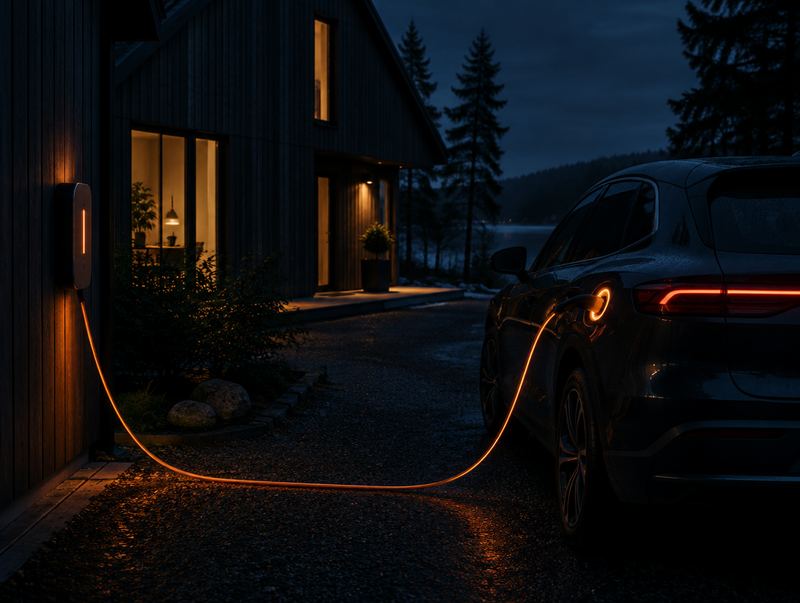
1 · The battery
A grid asset that is mostly parked.
≈ 2h of Sweden's average electricity use is stored in the fully electric fleet
432,709 cars × 60 to 70 kWh ≈ 26 to 30 GWh. Sweden used 134.2 TWh in 2025, about 15 GWh per hour. An order-of-magnitude estimate, and you can never use all of it: people need to drive tomorrow.
ISO 15118-20 is the open protocol for bidirectional charging, and EU AFIR requires support for it in charging infrastructure from 1 January 2027. Vattenfall's pilot runs 200 bidirectional chargers in SE3 and SE4 until 2028.
The technology is not the problem. Certificates are, and trust and orchestration.
Sources: Trafikanalys; Ekonomifakta (elanvändning 2025); DEFA/RISE (June 2026); Vattenfall (2026).

2 · The mesh node
When the network goes dark.
28 April 2025 the Iberian grid collapses across Spain and Portugal around midday
Mobile sites fell back to batteries rated roughly 2 to 8 hours. At the peak, more than half of mobile users in large parts of Spain had no signal, and more than 1 in 3 in Portugal.
A car is a radio with a 60 kWh battery. C-V2X sidelink (PC5) works vehicle to vehicle without a base station.
The open question: could a parked fleet carry critical messages for days, not hours?
Sources: GSMA Intelligence / Ookla (June and July 2025); INESC TEC (2025).
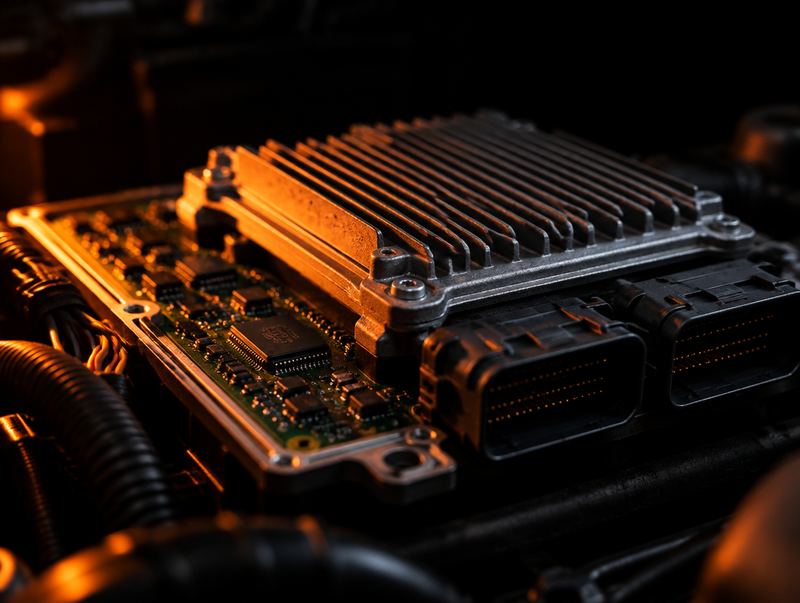
3 · The server on wheels
There's idle compute, basically everywhere.
254 TOPS from one NVIDIA DRIVE Orin system-on-chip, already in production cars; up to 2,000 for the next generation, DRIVE Thor
Parked, it is idle capacity. Moving, it is a sensor network: sensors, compute and connectivity, distributed across a national fleet and governed by absolutely nobody.
What decides real use: power budget, thermal limits, safety partitioning and owner consent.
Every one of those constraints is solved, or not solved, in software and architecture.
Sources: NVIDIA DRIVE platform pages; NVIDIA blog on DRIVE Thor.


03 The business
Some companies are already getting paid.
This is not only a resilience story. Three of the four roles already have a market. The fourth does not.
Battery to flexibility
Mobilize V2G, France.
Renault 5 owners get grid earnings on their power bill, est. €250 to 400 a year.
Paid by energy markets, via an aggregator
Sensors to data products
NIRA Dynamics, Linköping.
Road surface alerts from anonymised data, software in 120M+ vehicles.
Paid by carmakers and service providers
Compute to crowdsourced maps
Mobileye REM.
Millions of cars send about 10 KB per km to keep maps current.
Paid by carmakers licensing the maps
Network to readiness
No market exists yet.
Paying a parked fleet to stand by as a crisis network. The one that matters most when the lights go out.
Paid by: an open question
Sources: NewMobility (Oct 2024); Informed Infrastructure (Bosch/NIRA); Mobileye REM.
04 The perfect storm
Four gaps we keep avoiding.
So why is none of this infrastructure yet? Because infrastructure is not the hardware. It is the ability to rely on it: to know what it is, what state it is in, who controls it, and what happens when something breaks.
Trust
Who signs the update, and who can revoke it?
Integration
Hundreds of control units and suppliers. Nobody designed the whole system.
Lifecycle
Hardware lives 15 years or more. Software changes every month.
Sovereignty
Where is the backend, and who controls it in a crisis?
Dual use cuts both ways.
- The update channel that can mobilise a fleet can also disable it.
- The charging link that stabilises the grid can also destabilise it.
- The sensors that help a rescue operation can also track people.
The fleet is already part of the attack surface. The only choice is whether we govern it.
05 The rules are opening the vehicle
Who may read, write, update and delete?
Read the regulation the way we read a database. And the money follows the same four verbs.
Read Opening fast
- Data Act: access and sharing, by design from Sep 2026
- Batteries Art. 14: read-only health data
- 2026/699: diagnostics via APIs
Data products. Users may share data with third parties; data holders may charge fair compensation, cost only for SMEs.
Write Thin
- AFIR: ISO 15118-20 from 2027
- 2026/699: stricter checks when access changes the car
- Data Act: data, not control
Flexibility and services. V2G earnings, crisis services. The highest value and the thinnest rules.
Update Governed
- R155/R156 since July 2024
- 2026/699: update info by 2028
- CRA: chargers and add-ons, not the car
Lifecycle revenue. Features, fixes and security across a 15-year life.
Delete Barely addressed
- GDPR Art. 17: erasure
- Battery reset for second life
- New owner: who wipes what?
Second life and resale. Battery passport from 18 Feb 2027, incl. state of health. A trusted wipe makes resale possible.
We have regulated reading. Resilience is decided by writing. Whoever holds write access captures the value, and today that is decided brand by brand.
Sources: EU 2023/2854 (Data Act) and Art. 9 (Commission draft guidelines, Feb 2026); 2023/1542 Art. 14 and the battery passport; Del. Reg. 2026/699; 2023/1804 (AFIR); UNECE R155/R156; 2024/2847 (CRA); GDPR.
06 What it takes
Five engineering disciplines.
Not a moonshot. Five disciplines most of us already know, applied with a different level of seriousness.
- 01
Know what's running.
A configuration baseline and SBOM for every vehicle, not every model.
- 02
Design for degraded modes.
No network, no cloud, no backend. What still works?
- 03
Treat diagnostics as resilience.
Detect, isolate and explain faults in the field, at fleet scale.
- 04
Govern every write and update.
Authenticated, logged and reversible. R155 and R156 are the floor, not the ceiling.
- 05
Build on open interfaces.
ISO 15118-20, standardised V2X, documented APIs. Lock-in is a resilience risk.
Sources: UNECE WP.29 R155/R156; ISO 15118-20; EU AFIR.
07 Take it home
Three questions for your team.
- If the network disappeared tomorrow, what would your system still be able to do?
- Can you list exactly what software runs on every unit in the field?
- Who can write to your system, who can update it, and who can stop them?
If your team can answer all three with confidence, you are building infrastructure. If not, you are building something that will become infrastructure anyway, just without anyone being ready for it.

CEO, Diadrom Holding AB